Permitting Reform as Deregulation: Bottlenecks in Energy, Mining & Infrastructure
Imagine an energy company ready to build a new wind farm or transmission line, only to wait years for a permit.

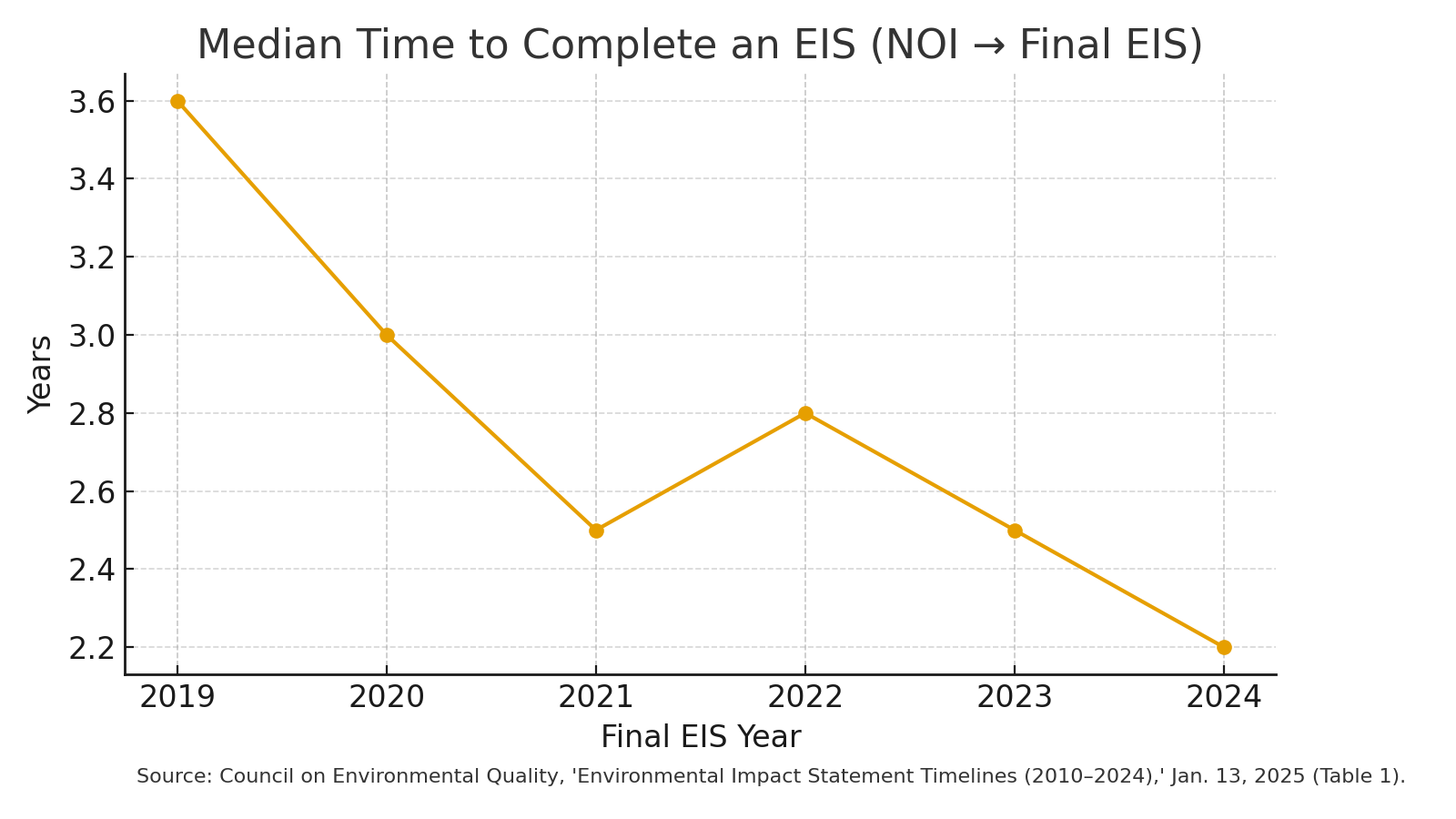
Imagine an energy company ready to build a new wind farm or transmission line, only to wait years for a permit. That’s the reality for many U.S. projects. Federal reviews under the National Environmental Policy Act (NEPA) often take more than four years on average, with costs that can reach millions per project¹. These delays tie up capital, slow construction, and deter private investment in sectors critical to the energy transition².
That’s why the Energy Permitting Reform Act (EPRA) has drawn rare bipartisan support in Congress. Introduced in 2024, the bill aims to shorten environmental reviews, speed federal approvals, and set enforceable deadlines for agencies handling energy, mining, and infrastructure projects³. The reform would require environmental assessments to finish within one year and full environmental impact statements within two⁴. It would also limit judicial challenges to 150 days, providing developers more clarity on timing⁵.
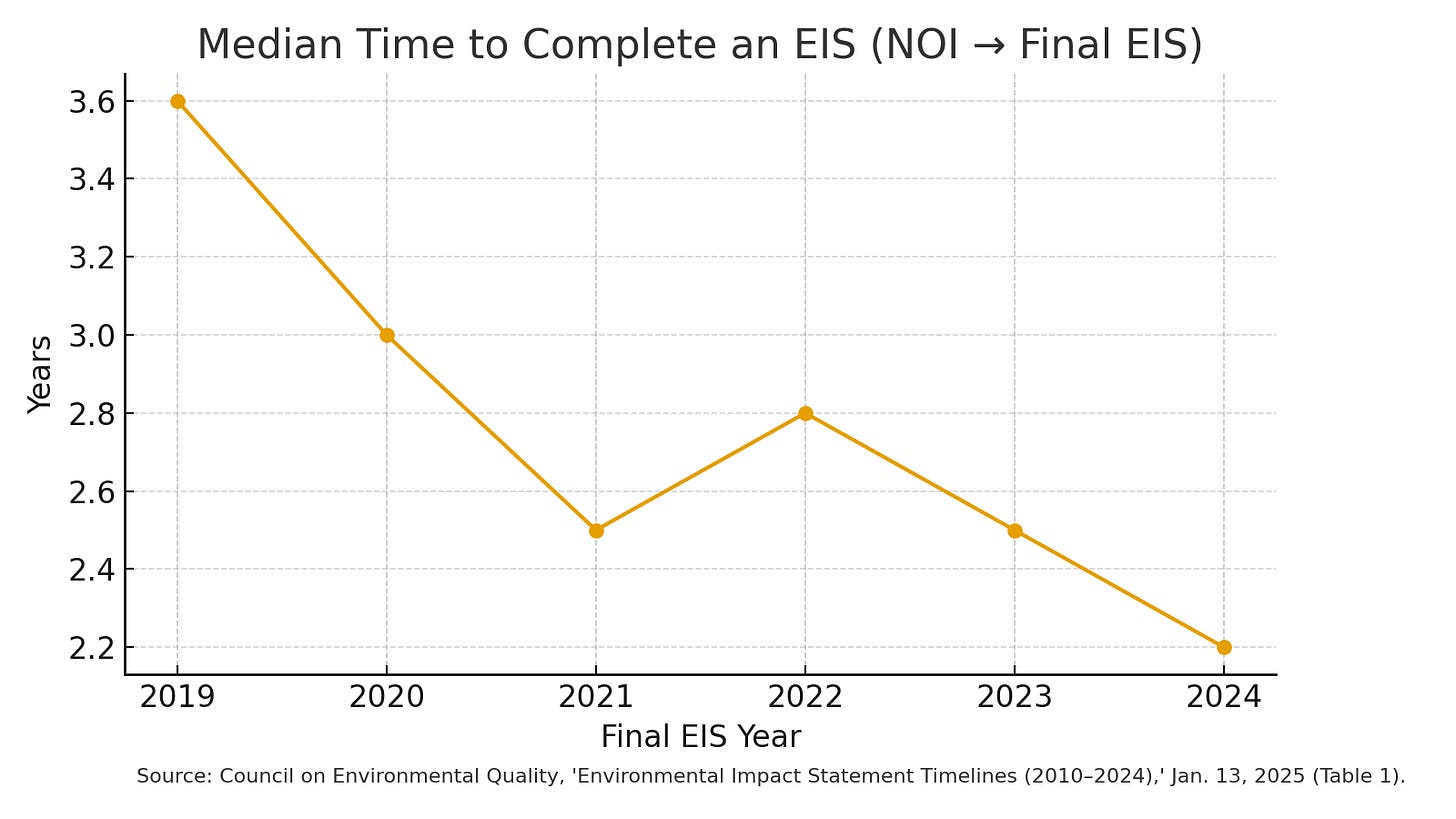
The logic is simple: clearer rules and faster approvals can make projects more investable. The Chamber of Commerce estimates it currently takes more than four years just to get a “yes or no” decision on a federal permit⁶. For developers, that delay can destroy economics by increasing financing costs and regulatory uncertainty. EPRA’s goal is to convert those open-ended timelines into predictable schedules—an approach that mirrors reforms already tested in the infrastructure space under the Biden administration’s Permitting Action Plan⁷.
Speeding up approvals could unlock billions in stalled projects. McKinsey estimates that roughly 650 major infrastructure projects—representing over $1 trillion in potential capital—remain tied up in review⁸. Shorter timelines would help not just renewables, but also natural-gas pipelines, battery facilities, and copper or lithium mines that feed the clean-energy supply chain. Mining reforms in the bill would streamline overlapping federal and state reviews, addressing the decades-long lag between mineral discovery and production⁹.
The investment takeaway is clear. Faster permitting improves capital efficiency. Developers can turn shovel-ready projects into operating assets sooner, reducing risk and freeing up cash flow. Publicly traded utilities, miners, and industrials stand to gain the most as backlogs clear. By contrast, continued regulatory gridlock could hold back U.S. competitiveness, especially as countries like Canada and Australia move to simplify their own permitting regimes.
Still, there are trade-offs. Critics worry that shorter deadlines could weaken environmental oversight or limit public participation¹⁰. Legal challenges from states or communities may persist even after federal reforms, keeping litigation risk alive. Investors, therefore, shouldn’t mistake “faster” for “frictionless.” What EPRA really promises is less uncertainty, not no controversy.
For markets, though, predictability itself is a kind of deregulation. If Washington delivers on that promise, it could shift sentiment across energy, mining, and infrastructure equities. Projects that once took a decade might finally move from blueprint to construction in a few years. In an era of constrained supply chains and rising demand for power, that’s not just policy—it’s a potential catalyst for capital.
Footnotes
- The White House, Fact Sheet: Permitting Progress to Build Infrastructure Faster, April 2024.
- Rennert, Kevin, and Molly Robertson, Resources for the Future, Oct. 2025.
- Durbin, Martin, and Chad Whiteman, U.S. Chamber of Commerce, July 2024.
- Ibid.
- Niskanen Center, “Why the Energy Permitting Reform Act Is a Necessary Step Forward,” Oct. 2024.
- U.S. Chamber of Commerce, Energy Permitting Reform Act of 2024 Overview, July 2024.
- The White House, Permitting Action Plan, April 2024.
- McKinsey & Company, Unlocking U.S. Federal Permitting, July 2025.
- U.S. Senate Committee on Energy and Natural Resources, Mining Regulatory Clarity Act Summary, 2024.
- Sierra Club, Press Release: EPRA Weakens Environmental Review, 2024.
The Free Markets Report is provided by Lead-Lag Publishing, LLC. All opinions and views mentioned in this report constitute our judgments as of the date of writing and are subject to change at any time. Information within this material is not intended to be used as a primary basis for investment decisions, and should also not be construed as advice meeting the particular investment needs of any individual investor. Trading signals produced by The Free Markets Report are independent of other services provided by Lead-Lag Publishing, LLC, or its affiliates, and the positioning of accounts under their management may differ. Please remember that investing involves risk, including loss of principal, and past performance may not be indicative of future results. Lead-Lag Publishing, LLC, its members, officers, directors, and employees expressly disclaim all liability with respect to actions taken based on any or all of the information in this writing.