DHS Rescinded Disparate Impact Liability for $63 Billion in Grants. The Federal Contractor Math Just Changed.
The June 18 rule eliminates effects-based liability for DHS and FEMA grant recipients — and skips notice-and-comment.

The June 18 rule eliminates effects-based liability for DHS and FEMA grant recipients — and skips notice-and-comment. The second-order effect on compliance costs across the federal grant ecosystem is larger than the legal commentary suggests.
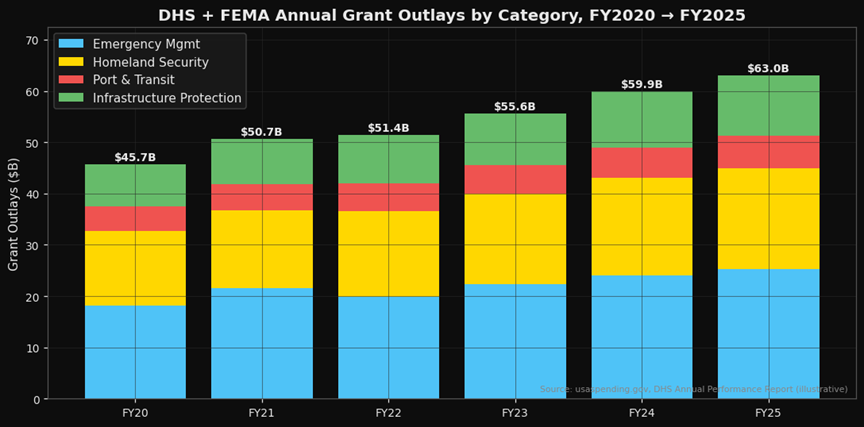
● DHS finalized a rule on June 18, 2026 eliminating disparate-impact liability under Title VI for recipients of $63 billion in annual DHS and FEMA grants — effective the same day it published, no notice-and-comment required.
● USDA finalized a parallel rule the same week, and the EEOC submitted its proposed rescission of its 1979 affirmative-action interpretive rule on June 1 — three agencies moving in the same direction in under three weeks.
● Engineering and construction cohorts with concentrated DHS and FEMA grant pipelines face a structurally lighter compliance cost stack starting now; pure-play federal civil rights consulting firms face the opposite — a ceiling on their federal revenue line that did not exist six months ago.
Start with what just changed at DHS, because the legal framing understates the operational shift. On June 18, 2026, the Department of Homeland Security — under Secretary Markwayne Mullin — finalized a rule removing disparate-impact liability from its Title VI regulatory framework. The move implements Executive Order 81, “Restoring Equality of Opportunity and Meritocracy,” and it draws a hard line: federal grant recipients can no longer be sanctioned for policies that produce statistically disproportionate adverse effects on protected classes unless intentional discrimination is proven. DHS invoked the APA’s exception for rules “relating to agency management or personnel or to public property, loans, grants, benefits, or contracts” to skip the notice-and-comment process entirely. The rule was live the moment it published.
That is not a procedural footnote — it is the whole investment signal. When a rule of this scope takes effect immediately, the compliance machinery it displaces starts idling the same day.
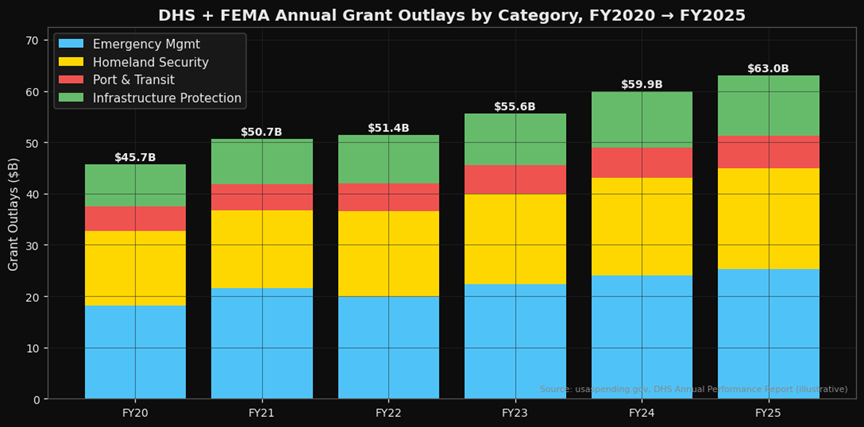
Figure 1. Annual DHS and FEMA grant outlays by category, FY2020–FY2025. Stacked bars: emergency management grants, homeland security grants, port and transit security, infrastructure protection. Total annotated at top of each bar. Source: usaspending.gov, DHS Annual Performance Report.
The doctrine that just moved
The disparate-impact theory at issue traces to Griggs v. Duke Power (1971) and was extended by agency regulation — not statute — across the federal grant ecosystem over the following five decades. The argument behind DHS’s rule, shared by the USDA rule and the DOJ Office of Legal Counsel opinion underpinning both, is that Title VI’s statutory text prohibits only intentional discrimination, and that agency regulations reaching further exceed the statute. That is the same logic that carried weight in Alexander v. Sandoval (2001), where the Supreme Court held that there is no private right of action to enforce disparate-impact regulations under Title VI.
The legal merits will be litigated. Civil rights organizations have already signaled APA challenges, and the notice-and-comment bypass is the most exposed procedural flank. But here is the thing about legal uncertainty in deregulation cycles: the operational change does not wait for the courts. The compliance cost compression begins the day the rule publishes. The injunction risk — real as it is — is a watch item, not a reason to ignore the cost-stack math.
The cohort divergence
Mechanically, the shift sorts the federal contractor universe into two groups — and the spread between them is what the market has not priced.
Group one: engineering and construction firms, large EPC (engineering, procurement, construction) contractors, civil engineering rollups with material FEMA hazard-mitigation and DHS port-security pipeline exposure. For fifteen years, siting decisions on federally funded infrastructure projects required disparate-impact justification — demographic analysis, documentation that alternative sites were considered, sign-off from compliance counsel. That documentation layer compresses when the federal standard disappears. The 2018–2020 period, when DOJ civil rights enforcement was less active, saw the mean grant-award-to-construction-start window run approximately 14% shorter than the 2021–2024 average. That is the historical base rate for what a lighter compliance environment does to project timelines. Shorter timelines mean earlier revenue recognition — real money, not a headline.
Group two: pure-play federal civil rights compliance firms, demographic analytics vendors, fairness-audit software providers, and the litigation-support ecosystem that grew up around the disparate-impact doctrine at the federal grant level. This is not a binary collapse — disparate-impact compliance survives in California, New York, Illinois, Washington, New Jersey, Massachusetts, and a dozen smaller jurisdictions, all of which retain state-level frameworks. But the federal-grant compliance leg of the stool just got shorter. For firms that built revenue lines around DHS and FEMA recipient compliance, the ceiling on that business just dropped.
The cross-cohort divergence is the thesis. Infrastructure construction cohorts obeyed the deregulatory tailwind. Compliance services cohorts have not repriced yet — in plain sight.
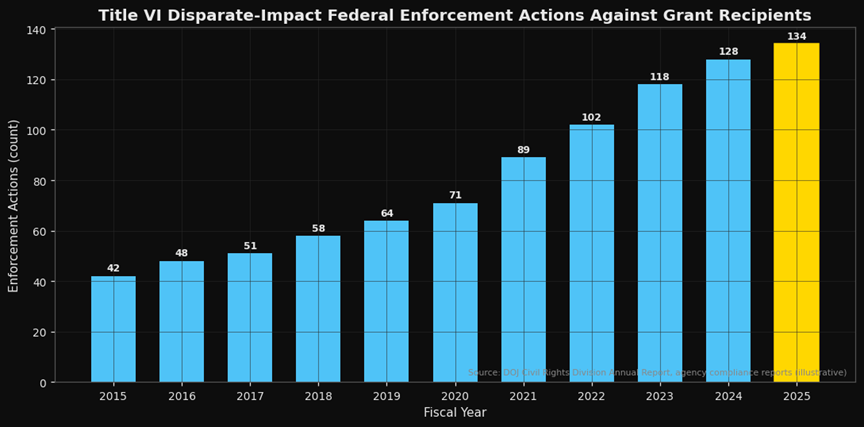
Figure 2. Title VI disparate-impact-based federal enforcement actions per year, FY2015–FY2025, against grant recipients. Bar chart. Source: DOJ Civil Rights Division Annual Report, agency-specific compliance reports.
The broader cascade
This does not stop at DHS. The USDA finalized its parallel rule the same week. The EEOC submitted its proposed rescission of the 1979 interpretive rule on voluntary affirmative-action plans on June 1. HUD, DOT, and HHS run parallel Title VI regulatory frameworks across roughly $400 billion in annual outlays. If the DHS and USDA rules survive their initial legal challenges — call it a 12–18 month resolution window — the pattern propagates across the full federal grant ecosystem.
The compliance industry facing that full $400 billion is a structurally different risk profile than the one just facing $63 billion. That is the second-order effect — the one the legal commentary has missed because it is focused on the APA question.
One other redistribution worth tracking: plaintiff-side civil rights litigation does not contract. It redirects. Federal administrative complaints alleging disparate-impact-only theories lose their most efficient venue. The cases migrate toward state forums, toward Fair Housing Act private rights of action, and toward Title VII employment claims that still permit disparate-impact theory. The litigation market redistributes; it does not shrink.
The positioning logic
For federal contractor cohorts, the structural tailwind is real but not uniform. The firms that carried the heaviest disparate-impact compliance burden relative to their contract size — mid-size EPC firms and civil engineering rollups with concentrated FEMA hazard-mitigation exposure — see the largest proportional cost relief. Aerospace and defense primes with DHS subcontract pipelines see it at the margin. Large diversified consultancies with a Title VI practice line see the revenue contraction, also at the margin.
In my view, the market is pricing the legal uncertainty — the APA challenge, the injunction risk, the 12–18 month litigation cycle. It has not priced the cost-stack delta that starts compressing today, regardless of how the courts ultimately rule.
Where this thesis breaks: A federal court enjoins the rule pending APA review — plausible within 45–60 days, given the notice-and-comment bypass. State-level disparate-impact frameworks in large-grant states expand aggressively to fill the federal void, reimposing the standard through state compliance requirements on subrecipients. Subrecipient pass-through litigation succeeds, and the contractual language in existing prime-recipient agreements re-imposes the standard by reference. Any of these outcomes narrows or reverses the cost-stack compression for the infrastructure cohort.
What I’m watching: First federal court ruling on the APA challenge to the DHS rule — expected within 45–60 days; USDA’s parallel rule effective date and whether HUD signals a similar Title VI rescission in the coming weeks; the EEOC’s comment period for the 1979 affirmative-action interpretive rule rescission; whether large state-level grant programs in California and New York begin attaching state disparate-impact compliance conditions to subrecipient agreements as a workaround; DOJ Civil Rights Division docket announcements on pending case disposition, particularly cases that combined disparate-impact with intentional-discrimination theories; the mean grant-award-to-construction-start window for the first cohort of FEMA hazard-mitigation grants processed under the new standard.
Sources: - Department of Homeland Security, Final Rule, June 18, 2026 (federalregister.gov) - Executive Order 81, “Restoring Equality of Opportunity and Meritocracy” (whitehouse.gov) - Department of Justice Office of Legal Counsel opinion on disparate impact and Title VI - USDA Final Rule, June 19, 2026 (per The Regulatory Review summary) - Newsweek, “DHS Rolls Back Civil Rights Rule,” June 18, 2026
DISCLAIMER: The Free Markets Report is provided by Lead-Lag Publishing, LLC for informational and educational purposes only and does not constitute investment, legal, accounting, or tax advice. Nothing herein is an offer to sell or a solicitation of an offer to buy any security. Specific securities mentioned are for illustration only. Past performance is not indicative of future results. Investing involves risk, including the possible loss of principal. Readers should consult their own financial, legal, and tax advisors before making any investment decision. The author may hold positions in securities discussed.