Washington Wrote a Noise Rule for Trains America Does Not Run
The FRA's new high-speed rail noise ceiling is optional, costs six figures, and matters mainly as a marker of how this week's deregulatory sequencing works.
The FRA's new high-speed rail noise ceiling is optional, costs six figures, and matters mainly as a marker of how this week's deregulatory sequencing works.
Key Highlights
- FRA proposed the first federal noise standard for trains above 160 mph, at 91 FR 48823, comments open until October 2, 2026.
- No US train runs above 160 mph today, and FRA states the fastest top out at 150 mph, so the standard governs service that does not yet exist.
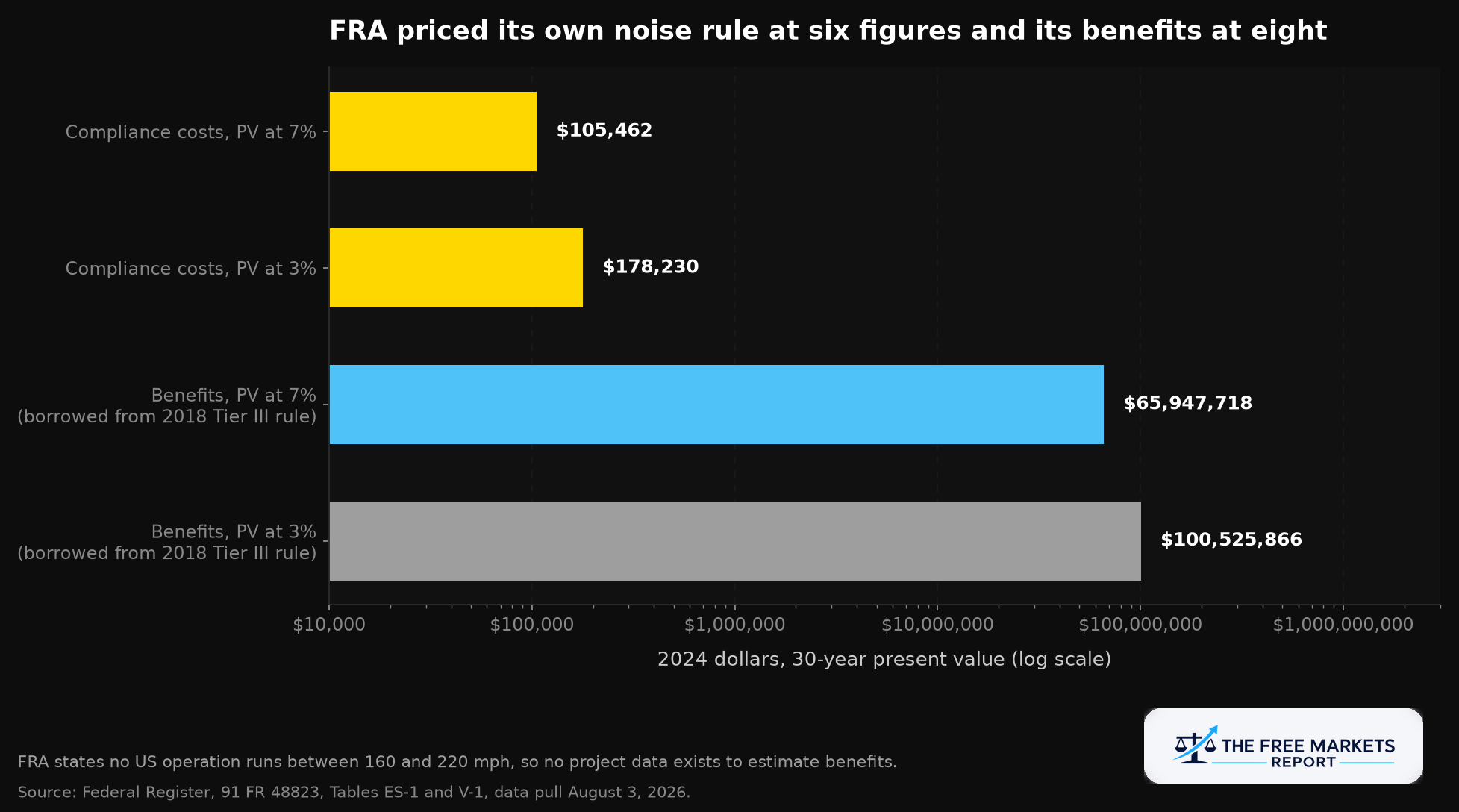
- FRA prices compliance at $105,462 in present value at 7 percent over 30 years, against $65,947,718 of benefits it calls "borrowed" from a 2018 rule.
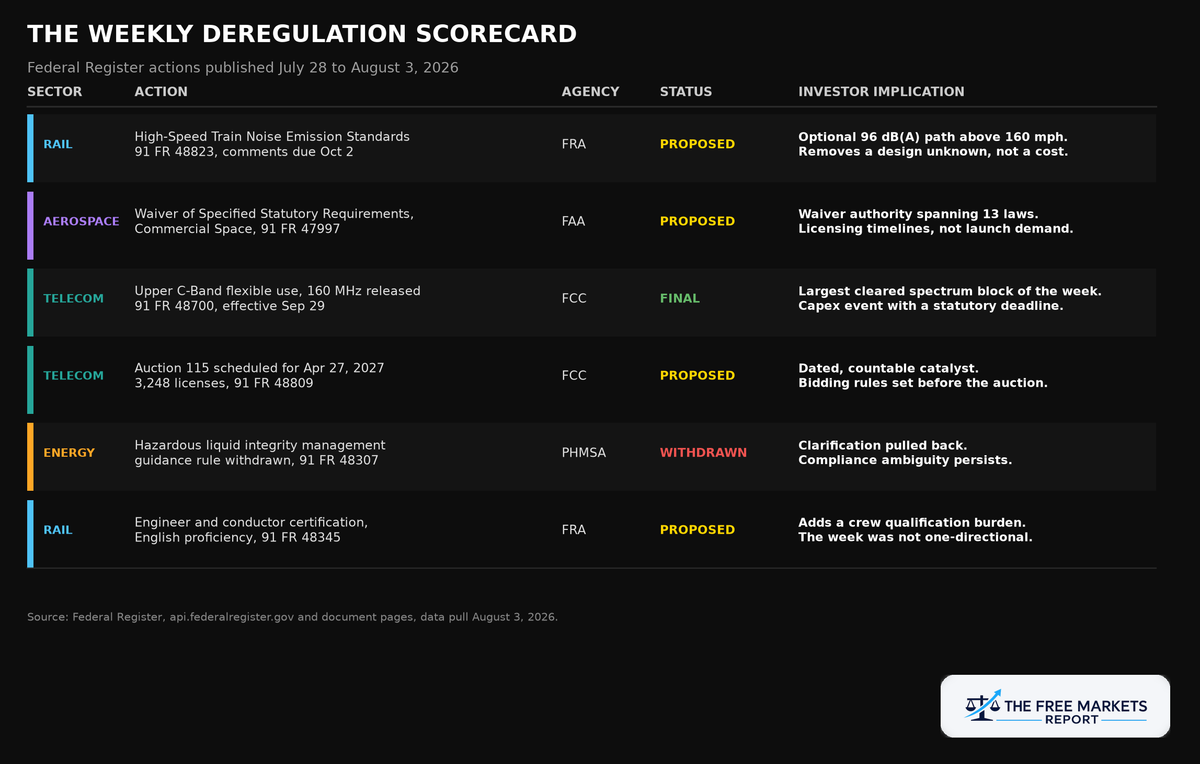
- The week's larger dollar events came from spectrum: the FCC released 160 megahertz of Upper C-band and set 3,248 licenses for auction on April 27, 2027.
Deregulation is usually described as the removal of a cost. This week it looked more like the removal of an unknown. This morning's FRA action cuts nobody's compliance bill by a meaningful amount. It writes down a number that did not exist before, for a service that does not yet run, so anyone contemplating building it knows the rule in advance. That is a different policy product, and it is valued differently.
A Rule for 220 mph in a 150 mph Country
Section 22423 of the Infrastructure Investment and Jobs Act, signed November 15, 2021, amended the Noise Control Act to let the Secretary of Transportation, with EPA, set noise standards for trains above 160 mph, including maglev. Nearly five years later, FRA has used it.
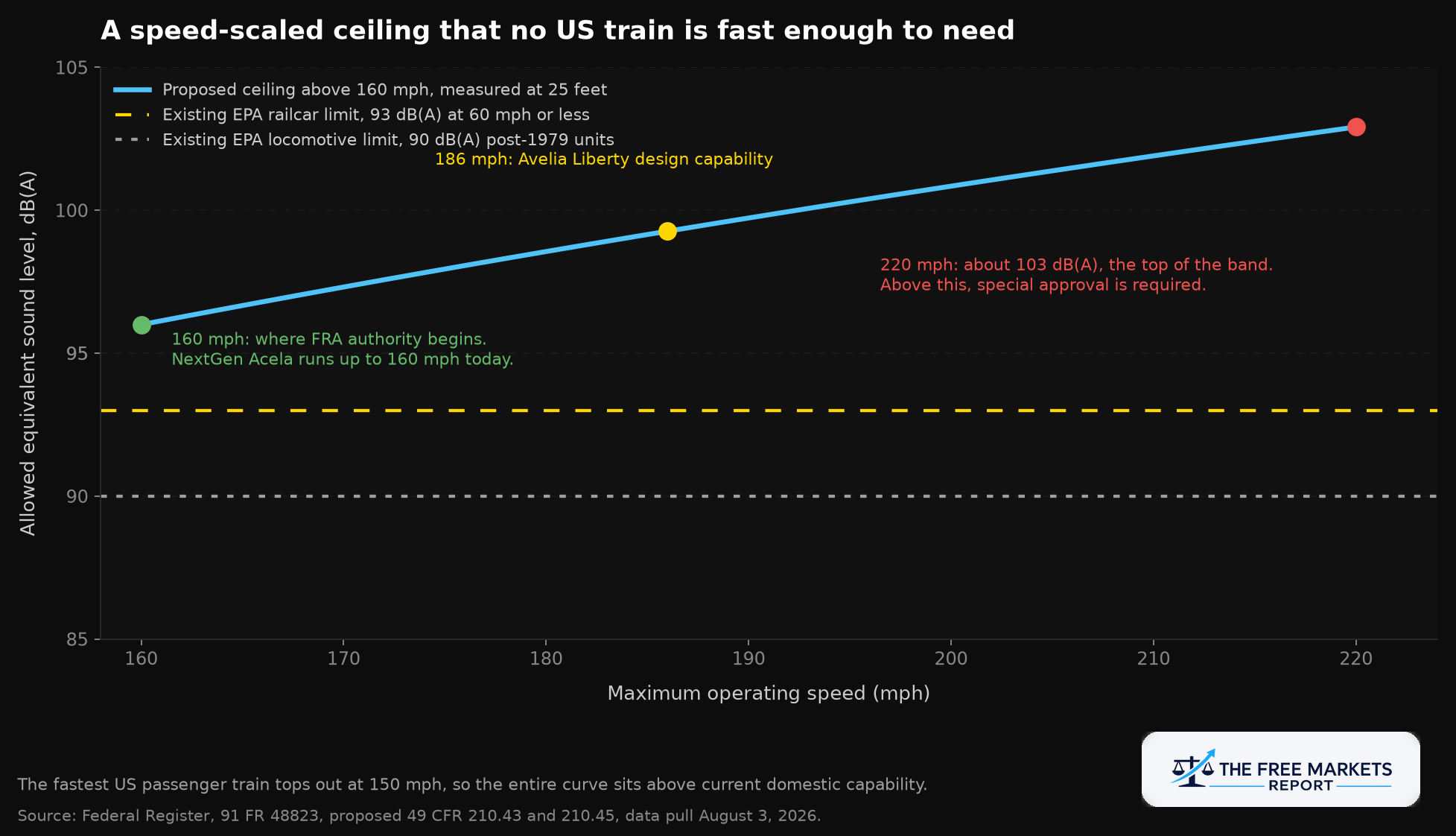
The mechanism is narrow. Proposed 49 CFR 210.43 would cap the equivalent sound level at maximum speed, normalized back to 160 mph, at 96 dB(A), subtracting 50 times the log of the speed ratio. At 220 mph that works out to roughly 103 dB(A) as measured, and anything faster needs special approval. Testing moves to 25 feet from the track centerline, replacing a 100-foot position built on 1976 data collected when the maximum allowable passenger speed here was 110 mph.
Start with the numbers. Equipment accounts for $62,091, labor $16,745, calibration $5,916, and special approval petitions $20,709, across an assumed four to six operations over 30 years. Annualized, the rule costs $8,499. FRA calls it deregulatory under Executive Order 14192 because total costs fall below zero once the alternative compliance path is credited. A rule that costs less than one engineering salary is not an earnings event. It is a permission slip.
Who Actually Builds These Trains
FRA names six trainset makers in its small-entity analysis: Alstom, Hitachi Rail, Kawasaki, Siemens Mobility, Stadler and Talgo. Two have disclosed US high-speed work.
Alstom (Paris: ALO, ADR: ALSMY) won the Amtrak order in August 2016: 28 Avelia Liberty trainsets for 1.8 billion euros, or 2 billion dollars with support and spares, built at Hornell, New York, capable of 186 mph. That is roughly 1.7 percent of the 104.4 billion euro backlog Alstom reported at March 31, 2026, and the trains are already arriving, with 13 sets in service as of July 6, 2026, running commercially up to 160 mph. Siemens Mobility was named preferred bidder in May 2024 for ten "American Pioneer 220" trainsets for Brightline West, rated to 220 mph, value undisclosed, subject to definitive agreements.
That is the honest scale: disclosed in one case, undisclosed in the other, and small either way.
The Case for Skepticism
The strongest bear argument: this rule changes nothing an investor can underwrite.
Compliance is optional. Existing EPA limits of 90 dB(A) for post-1979 locomotives and 93 dB(A) for railcars remain available, and "no railroad would be required to avail itself of the alternatives." Zero US trains qualify for the new band. The benefit total is a borrowed proxy, not issuer cash flow. And the projects FRA cites carry a disclaimer that the list is "not an endorsement of any project or any guarantee of future Federal funding."
The pipeline supports the skeptics. Brightline West sits in the DOT Build America Bureau credit pipeline, as of June 1, 2026, seeking a 6,000 million dollar RRIF loan against 21,050 million dollars of eligible cost, close projected in fiscal 2027. Cascadia remains in planning on a 49.7 million dollar FRA grant. The week's rail docket also ran both directions: FRA separately proposed English proficiency requirements for engineers and conductors, which adds burden.
Ideas to Watch: Week of August 3, 2026
- Alstom (Paris: ALO, ADR: ALSMY), rolling stock. Its 1.8 billion euro Amtrak contract is roughly 1.7 percent of a 104.4 billion euro backlog, and those trains run up to 160 mph. What to watch: deliveries past 13 in-service sets, and any follow-on US order specifying speeds above 160 mph.
- Siemens (SIEGY), rolling stock. Siemens Mobility is preferred bidder, not contracted supplier, for ten Brightline West trainsets rated to 220 mph, value undisclosed, and the project rests on a 6,000 million dollar RRIF loan request. What to watch: conversion into a definitive agreement, which is what would make the 220 mph ceiling relevant to a listed issuer.
- The comment file, closing October 2, 2026. Docket FRA-2025-0786 will show which of the six named manufacturers engage the 96 dB(A) normalization and the 25-foot measurement position. What to watch: comments arguing the geometry binds design, which converts a definition into an engineering constraint.
The falsification condition is specific. If that file closes with no manufacturer or operator engaging the standard, and the Brightline West entry has not advanced past a projected fiscal 2027 close, the enabling-rule reading is wrong and this is housekeeping.
The Week's Signal
Weeks like this reward reading mechanism, not headlines. Spectrum moved 160 megahertz and a dated auction. Rail moved a definition, priced at $8,499 a year.
Regulators clear the path before capital arrives, not after. That sequencing is the opportunity and the risk: a cleared path is not a funded project. The distance between them is measured in financing closes, not Federal Register pages.
- Federal Register, "High-Speed Train Noise Emission Standards," document metadata (91 FR 48823, RIN 2130-AC83, Docket No. FRA-2025-0786, comments close October 2, 2026). federalregister.gov
- Federal Register, full text of 91 FR 48823 (proposed 49 CFR 210.43, 210.45, 210.55, 210.63; Tables ES-1 and V-1; IIJA Section 22423; E.O. 14192 classification; small-entity analysis). federalregister.gov
- Federal Register, FCC, "Upper C-Band (3.98-4.2 GHz); Expanding Flexible Use of the 3.7 to 4.2 GHz Band," 91 FR 48700, July 31, 2026. federalregister.gov
- Federal Register, FCC, "Auction of Flexible-Use Licenses in the Upper C-Band for Next Generation Wireless Services, Auction 115," 91 FR 48809, August 3, 2026. federalregister.gov
- Alstom, "Alstom to provide Amtrak with its new generation of high-speed train," August 26, 2016. alstom.com
- Alstom, "Alstom's fiscal year 2025/26 results," May 13, 2026. alstom.com
- Amtrak Media, "NextGen Acela Fleet Continues to Grow," July 6, 2026. media.amtrak.com
- Brightline, "Brightline West Selects Siemens to Manufacture High-Speed Rail Train Sets," May 1, 2024. gobrightline.com
- US Department of Transportation, Build America Bureau Credit Assistance Pipeline, information as of June 1, 2026. transportation.gov
- Washington State Department of Transportation, Cascadia High-Speed Rail program page. wsdot.wa.gov
- Federal Register, FRA, "Qualification and Certification of Locomotive Engineers and Conductors; English Language Proficiency and Other Requirements," 91 FR 48345, July 31, 2026. federalregister.gov
The Free Markets Report is provided by Lead-Lag Publishing, LLC. All opinions and views mentioned in this report constitute our judgments as of the date of writing and are subject to change at any time. Information within this material is not intended to be used as a primary basis for investment decisions, and should also not be construed as advice meeting the particular investment needs of any individual investor. Trading signals produced by The Free Markets Report are independent of other services provided by Lead-Lag Publishing, LLC, or its affiliates, and the positioning of accounts under their management may differ. Please remember that investing involves risk, including loss of principal, and past performance may not be indicative of future results. Lead-Lag Publishing, LLC, its members, officers, directors, and employees expressly disclaim all liability with respect to actions taken based on any or all of the information in this writing.
Related coverage: The FCC Put a 120-Day Clock on City Hall. It Is Only a Proposal.; The FCC Just Handed AT&T a Wrecking Ball for Its Own Copper