When Money Costs 5%, Red Tape Is the Most Expensive Thing in the Market
Why the Free Markets ETF (FMKT) is built for a market where rate cuts are not coming to the rescue

Why the Free Markets ETF (FMKT) is built for a market where rate cuts are not coming to the rescue
By Michael A. Gayed, CFA | Data through October 23, 2026
KEY HIGHLIGHTS
- The setup changed. High-yield credit spreads widened from 260 basis points on August 28 to 340 on October 22, and the 10-year Treasury yield closed at 4.99% on October 23.1,2 Over the past month, energy beat the S&P 500 by 11.7 percentage points while technology lagged by 5.0.3
- The thesis. The Fed sets the price of money. Washington sets the cost of doing business. When capital costs 5%, a rule that disappears or a permit that arrives a year early is worth more than it was when money was nearly free.
- The calendar. This is not a forecast. The Environmental Protection Agency (EPA), Federal Communications Commission (FCC), Federal Energy Regulatory Commission (FERC) and Securities and Exchange Commission (SEC) have taken dated actions since August 31, with hard deadlines on December 21, December 31 and June 30, 2027.4,5,6,7,8
- The holdings. Chevron, ConocoPhillips, APA, Delek US, Tradeweb, American Tower and Teva are Free Markets ETF (FMKT) holdings tied to specific rule changes, not to a rate cut.9
- Why FMKT. The Free Markets ETF is an actively managed fund that seeks to invest in companies positioned to benefit from federal deregulation. Its catalyst is the Federal Register, not the Fed's next meeting.
- The risk. Policy can reverse, proposals can stall, and energy is cyclical. I cover what would make me wrong at the end.
I co-launched the Free Markets ETF and helped bring the strategy to market, so read this with that in mind.
THE MARKET JUST CHANGED ITS MIND
For most of the past year, the market priced a simple story: rates come down, growth holds up, and the largest technology companies keep carrying the index. That story is cracking.
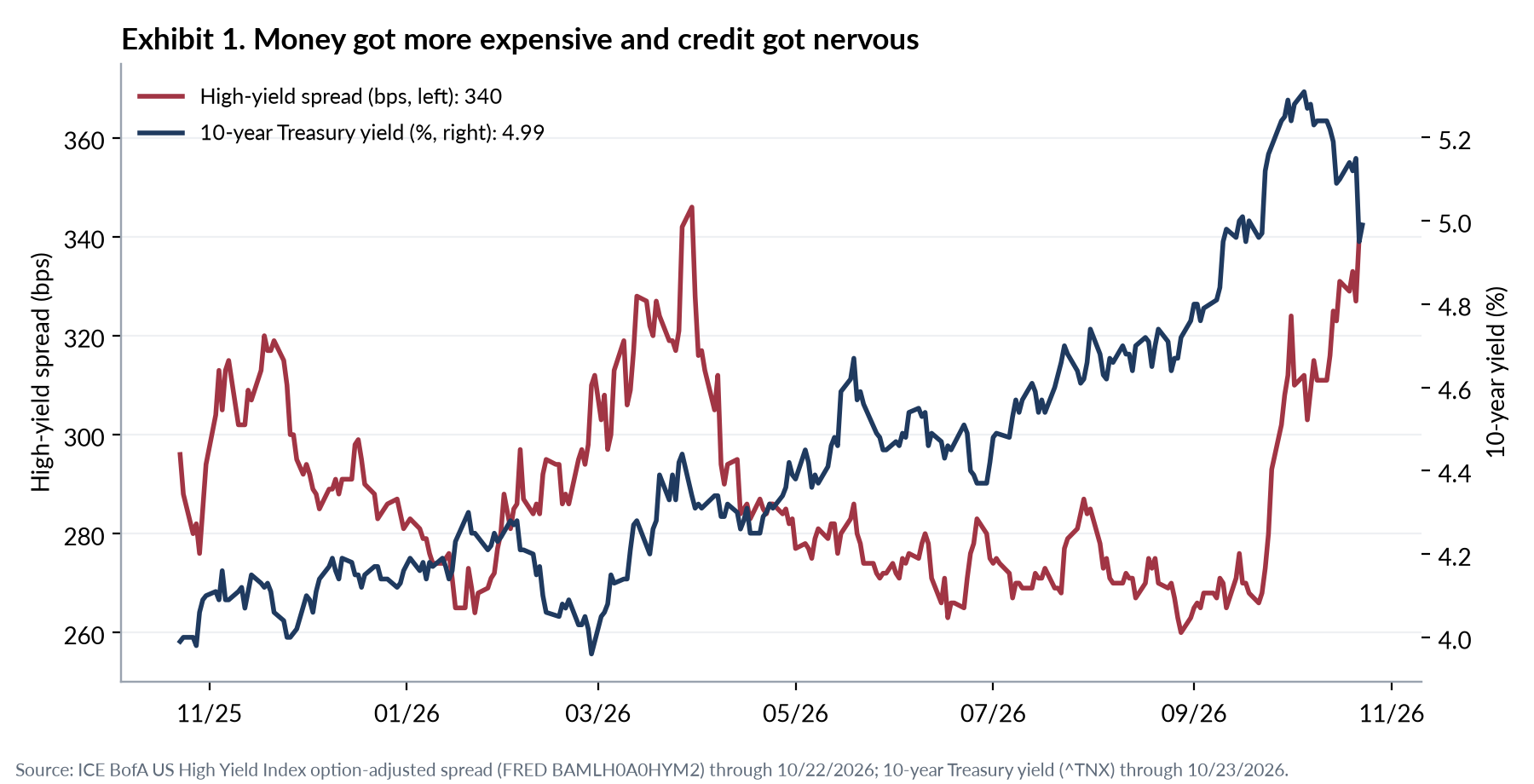
Look at credit first, because credit usually figures it out before equities do. High-yield spreads, the extra yield investors demand to own junk bonds over Treasuries, bottomed at 260 basis points on August 28. By October 22 they were at 340.1 That is an 80 basis point move in under two months. It is not a crisis. Spreads are still below their long-run average. But it is a change in direction, and direction is what matters.
At the same time, money did not get cheaper. The 10-year Treasury yield closed at 4.99% on October 23.2 So credit got nervous while the risk-free rate stayed near 5%. That combination is the opposite of what a market expecting an easy landing wants to see.
Exhibit 1 shows both lines together.
Then look at what led. Over the month through October 23, the S&P 500 fell 0.9%. Underneath that small number was a big rotation. Energy beat the index by 11.7 percentage points. Utilities beat it by 9.1, staples by 9.0 and health care by 6.5. Technology lagged by 5.0 and communication services by 6.5.3
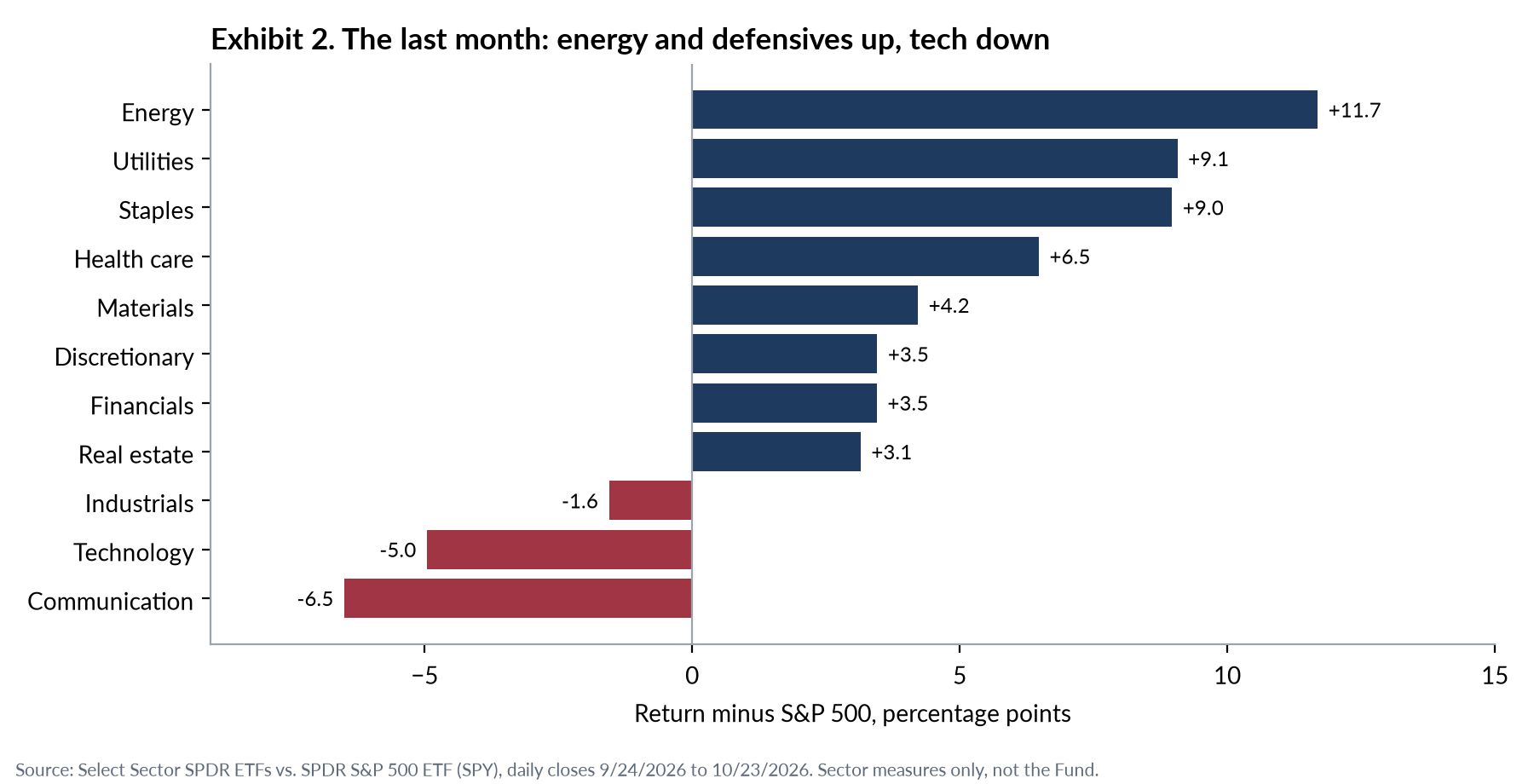
Defensive sectors leading at the same time as energy is not a random pattern. It is what a market looks like when investors start asking which earnings depend on easy money and which do not.
That question is exactly where deregulation comes in.
THE FED SETS THE PRICE OF MONEY. WASHINGTON SETS THE COST OF DOING BUSINESS.
Most investors treat policy as one thing. It is two.
Monetary policy sets the price of capital for everyone at once. When the Fed cuts, every company's discount rate falls together. When it holds, every company waits together. That is why so much of the market moves as one trade, and why a market that has priced in cuts gets hit when they do not show up.
Regulatory policy is different. It does not move everyone. It changes the cost structure of specific industries, sometimes specific companies, on specific dates. A methane rule rolled back lowers compliance spending for oil and gas producers. A clearing mandate pushes more Treasury trading onto electronic venues. A spectrum release gives wireless carriers more airwaves to fill with equipment. None of those outcomes depend on what the Fed does at its next meeting.
That is the core of how I think about the Free Markets ETF. The Fund seeks to invest in companies positioned to benefit from federal deregulation. In a market obsessed with the next rate decision, those companies have a catalyst that does not need the Fed to cooperate.
WHY EXPENSIVE MONEY MAKES DEREGULATION WORTH MORE
Here is the part I think the market is missing. Deregulation is not just a nice-to-have when rates are high. It becomes more valuable when rates are high.
Think about what a permitting delay actually costs. When a company commits capital to a project, that capital sits idle until the project is allowed to produce. Every month of waiting is a month of financing cost with no revenue against it. The cost of that waiting scales with the cost of money.
Exhibit 3 does the simple arithmetic on $1 billion of committed capital. At a 2% cost of capital, a one-year delay costs about $20 million. At 5%, the same delay costs about $50 million. Stretch the delay to three years and the gap widens from roughly $61 million to roughly $158 million.
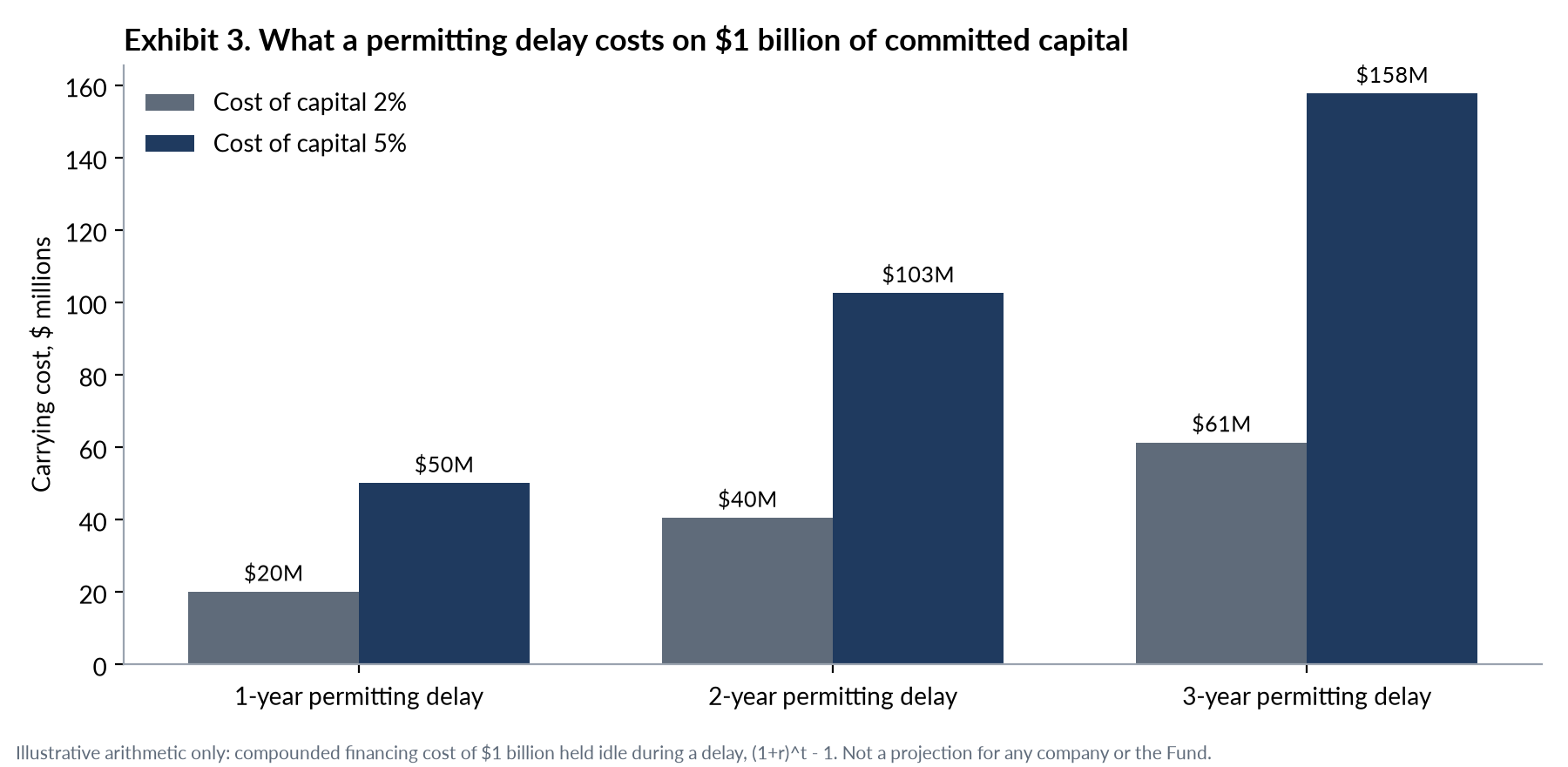
This is illustrative math, not a projection for any company. But the logic holds. When money was nearly free, a slow permit was an annoyance. At 5%, it is a line item. So the agencies that are shortening timelines, cutting compliance overlays and removing case-by-case approvals are handing a bigger check to the companies affected than they would have in 2021.
The same logic applies to compliance spending. A dollar a company no longer has to spend on a rule is a dollar it does not have to raise in the capital markets. When high-yield borrowers are paying 340 basis points over Treasuries that already yield close to 5%, internally freed cash is the cheapest capital there is.
THE CALENDAR IS DATED, NOT HYPOTHETICAL
The most common pushback I hear on deregulation is that it is a slogan. Fair. Much of what gets called deregulation in financial media is a press release or a campaign promise. So let me be specific about what has actually happened since the end of August.
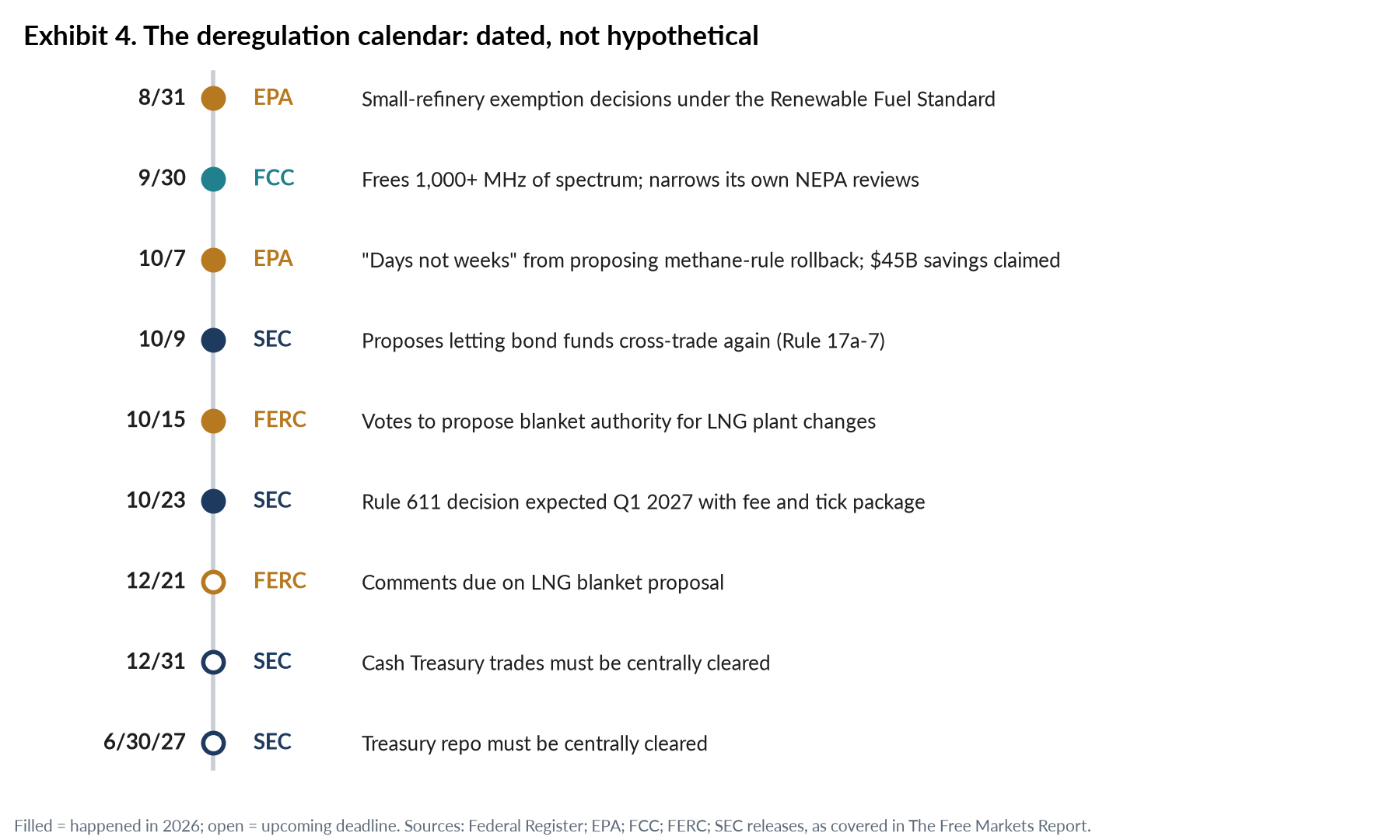
On August 31, the EPA issued decisions on small-refinery exemption petitions under the Renewable Fuel Standard, granting full exemptions to 18 petitions and partial exemptions to 11.4
On September 30, the FCC freed more than 1,000 megahertz of spectrum in the 12.7 GHz and 42 GHz bands and modernized how it handles its own environmental reviews under the National Environmental Policy Act.5
On October 7, EPA Administrator Lee Zeldin said the agency was "days not weeks" from proposing the second part of its reconsideration of the 2024 oil and gas methane rules. The EPA estimates the proposal would save $45 billion and attributes $18 billion in regulatory costs to the 2024 rule.6
On October 9, the SEC proposed amending Rule 17a-7 so registered funds can again cross-trade most fixed income with affiliates. The SEC estimates about $173 million a year in transaction-cost savings and calls that a lower bound.7
On October 15, FERC voted unanimously to propose a blanket program that would let liquefied natural gas (LNG) plant operators make eligible changes without case-specific authorization orders. Comments are due December 21.8
And on December 31, cash Treasury trades must be centrally cleared, with repo following by June 30, 2027.10
Some of these are final. Some are proposals, and proposals can change. But every one is a dated government action with an identifiable set of winners. That is what makes this investable.
ENERGY: FROM PERMITS TO PRODUCTION
Energy is where the deregulation story shows up most clearly in the numbers, and it is the largest sector in the Fund.
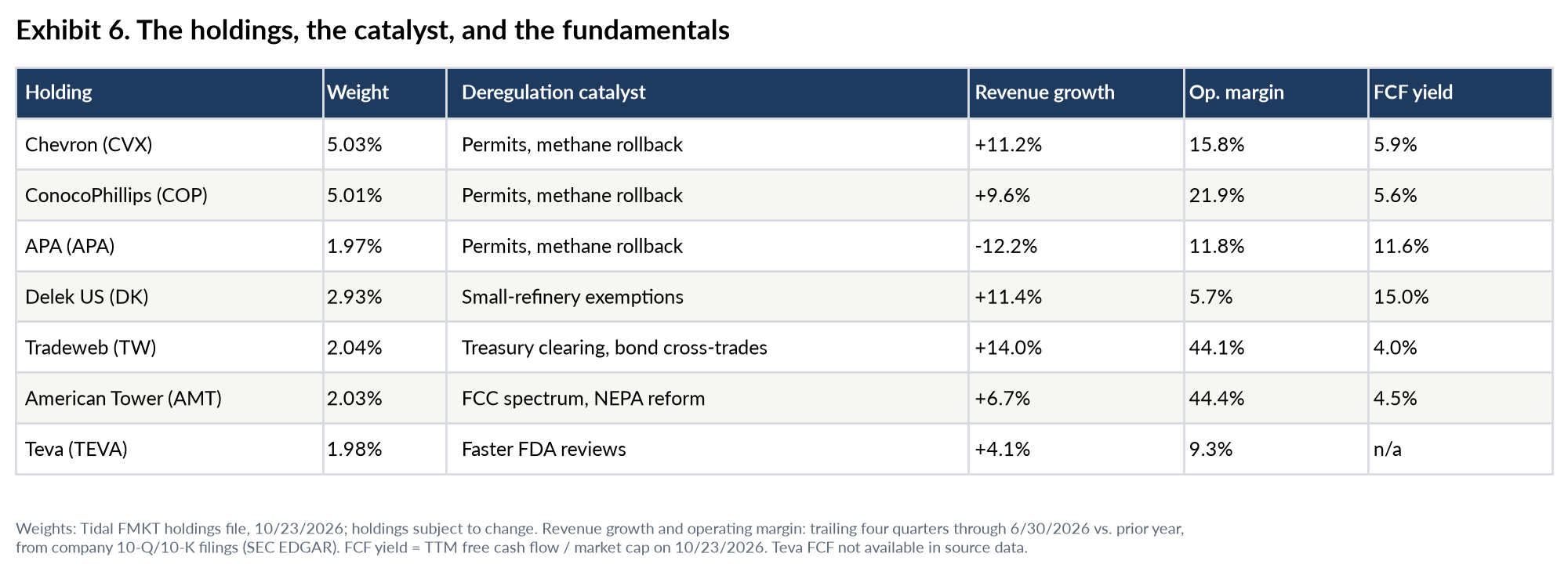
Chevron is the cleanest example. In its second quarter of 2026, Chevron reported earnings of $12.1 billion with record U.S. production, and worldwide production up 20%.11 ConocoPhillips reported six-month 2026 earnings of $6.1 billion, or $5.00 per share.12 APA reported second-quarter net income of $747 million and hit a new 52-week high on October 21.13
These companies operate under a federal posture that is speeding leases and permits, and the EPA's methane reconsideration goes directly at their compliance costs. The Environmental Defense Fund disputes the EPA's savings estimate and argues the rollback has real environmental costs.6 That debate will continue. For the producers, the direction of federal policy is clear.
Refining is the second leg. Delek US runs smaller refineries, the category the Renewable Fuel Standard exemptions are designed for. In its latest quarter, Delek reported earnings per share of $5.48 against a consensus estimate of $2.67, on revenue up 47.9% from a year earlier.14
The broad market has noticed some of this. Over the twelve months through October 23, the energy sector outperformed the S&P 500 by about 38% on a relative basis.15 That figure is a sector measure, not the Fund or its holdings. Past performance does not guarantee future results.
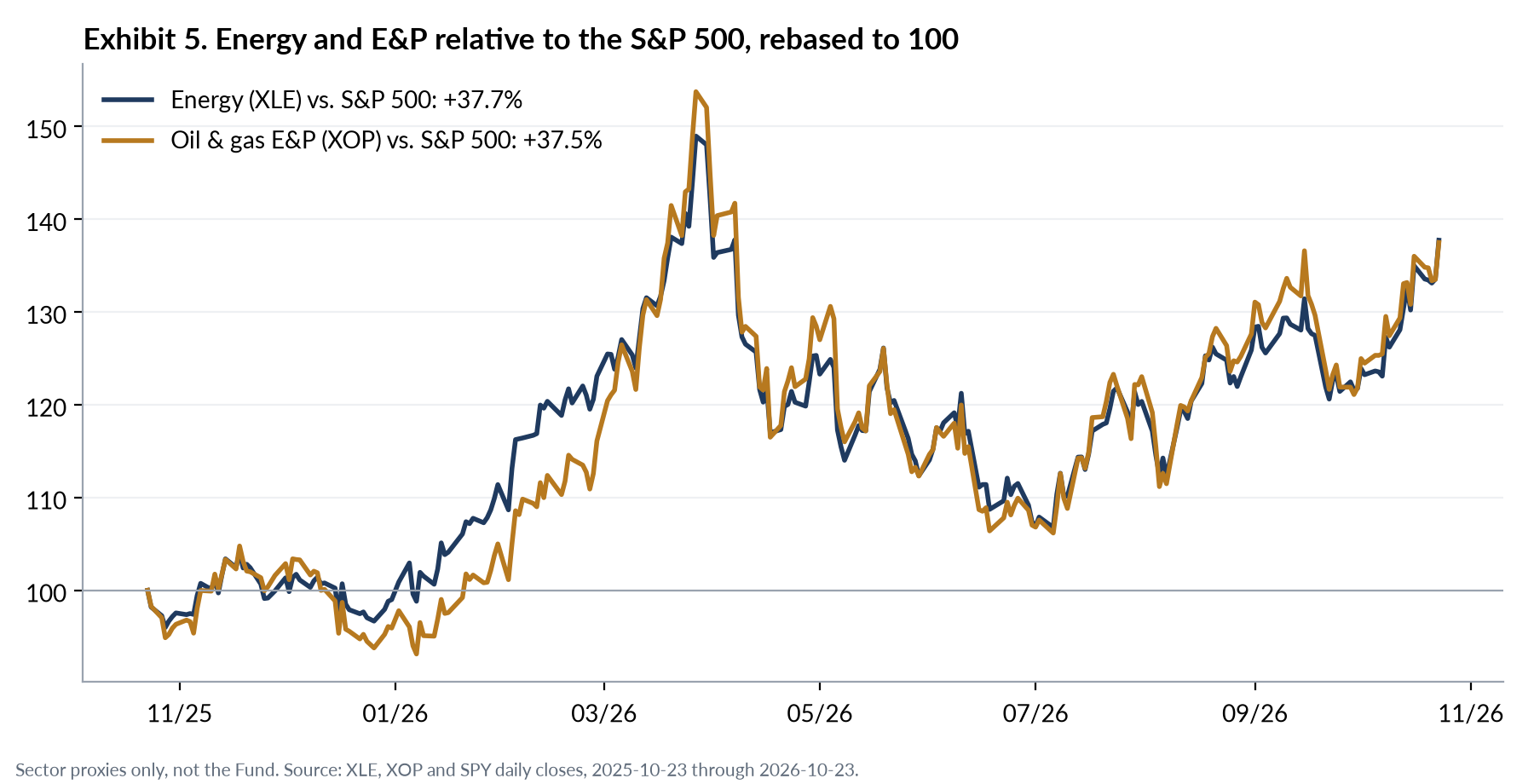
I do not think that move finishes the story. Prices have reacted to individual events. The regulatory regime that produced those events is still in place, and several of its biggest decisions, including the methane proposal and the LNG blanket program, have not been finalized. That unfinished calendar is why energy is the largest sector in FMKT.
MARKET PLUMBING: VOLATILITY IS A BUSINESS
The second theme is less obvious and, in a nervous market, may be more important.
When credit spreads widen and rates move, trading volume rises. The companies that run the pipes of the financial system earn more when more flows through them. And right now, Washington is rewriting the rules for those pipes.
Tradeweb operates electronic marketplaces for rates, credit, equities and money markets. Two SEC actions point in its direction. The Treasury clearing mandate pushes cash Treasury trading into central clearing by December 31, a structural shift toward electronic, standardized execution.10 And the SEC's October 9 cross-trade proposal says funds could price those trades using unaffiliated sources, which the SEC says can include electronic trading platforms.7
That second detail matters. Average quarterly corporate-bond cross trades between mutual funds fell from about $6.24 billion before the 2020 valuation rule to about $0.85 billion after it.7 If the SEC restores that activity and allows electronic platforms to serve as the price referee, the venue that prices bond trades gains relevance.
Tradeweb is also adding scale in credit. On October 19, it agreed to acquire Trumid for about $1.97 billion.16 Over its trailing four quarters, Tradeweb grew revenue 14.0% with an operating margin of 44.1%.17 This is the kind of exposure most investors do not associate with deregulation, and it is a big part of why FMKT is not just an energy fund.
SPECTRUM, DATA CENTERS AND THE FDA
The third theme is the one people forget because it does not look like a classic deregulation trade.
American Tower leases communications sites to wireless carriers and owns the CoreSite data-center business. The FCC's September 30 spectrum order adds more than 1,000 megahertz of airwaves to the market, and its National Environmental Policy Act (NEPA) modernization narrows the federal environmental review that applies to its own actions.5 More spectrum in use means more equipment on towers. American Tower reached a new one-year high in late October on record data-center leasing.18
Teva is the health care example. Teva is one of the world's largest generic drug makers and is building a branded portfolio. On October 9, the Food and Drug Administration (FDA) approved Weltruza, an extended-release injectable for schizophrenia.19 For a company like Teva, every approval that arrives sooner is revenue that arrives sooner, and in a 5% world, sooner is worth more.
Exhibit 6 pulls these holdings together: the weight in the Fund, the catalyst, and the fundamentals as reported. Different industries, same driver. That is the portfolio logic behind FMKT.
WHY FMKT, WHY NOW
Everything above is a sector-by-sector story. The problem for most investors is that you cannot easily own it that way.
A sector index buys every company in an industry by size. It owns the companies that typically benefit from a rule change and the ones that do not. An energy index does not care whether a producer's compliance bill just fell. A financials index does not know which firm runs the venue that Treasury clearing pushes trading onto. The deregulation story cuts across sectors, and broad indexes are not built to follow it.
That is the gap the Free Markets ETF is designed to fill. FMKT seeks to invest in companies positioned to benefit from federal deregulation, across energy, financials, health care, industrials and real estate. Our portfolio managers actively manage FMKT, using proprietary research to stay ahead of policy shifts, which can offer advantages over passive approaches. When a rule is proposed, finalized, delayed or reversed, the portfolio can respond. An index cannot.
For advisors, the practical use is as a satellite position around core index holdings. The core captures the market. FMKT targets a specific driver the core does not isolate: policy that changes what companies earn, on a dated calendar, whatever the Fed does next.
That matters more now than it did a year ago. With the 10-year near 5% and credit spreads widening, a portfolio that depends on rate cuts is making one big bet. FMKT adds a different one.
WHAT WOULD MAKE ME WRONG
I would not trust anyone who presents a thesis without its risks, so here are mine.
Policy can reverse. A future administration, a court ruling or a legislative change can undo rules that look settled today. Several of the actions above are proposals, not final rules, and the methane reconsideration in particular faces organized opposition and likely litigation.
Energy is cyclical. Record production does not protect producers from a fall in oil prices, and a global slowdown would hit energy earnings regardless of what happens in Washington.
Concentration cuts both ways. A fund built around companies that benefit from federal deregulation will look different from the S&P 500. That difference can help when policy is the driver and hurt when it is not.
And widening credit spreads are a warning, not a buy signal. If spreads keep widening, every risk asset is likely to feel it, including the companies in this piece.
THE BOTTOM LINE
The market is starting to separate earnings that depend on easy money from earnings that do not. Credit has widened, the 10-year is near 5%, and leadership has rotated toward energy and defensives.
In that environment, I want catalysts that do not wait for the Fed. Deregulation is one. It is dated, it is specific, and in a world where capital costs 5%, it is worth more than it has been in years. The Free Markets ETF was built to give investors a direct expression of that thesis.
Read the prospectus before you invest, and if you are an advisor who wants to talk through how FMKT fits alongside a core allocation, I am happy to have that conversation. If you want to see how it is positioned, the Fund's current holdings, prospectus and fact sheet are at freemarketsetf.com.
ENDNOTES
1. ICE BofA US High Yield Index option-adjusted spread, FRED series BAMLH0A0HYM2: 260 bps on 2026-08-28 and 340 bps on 2026-10-22. fred.stlouisfed.org/series/BAMLH0A0HYM2
2. U.S. 10-year Treasury yield (^TNX), daily close 2026-10-23.
3. Select Sector SPDR ETFs (XLE, XLU, XLP, XLV, XLK, XLC and others) vs. SPDR S&P 500 ETF (SPY), daily closes 2026-09-24 to 2026-10-23. Sector measures only.
4. EPA, Notice of August 31, 2026 Decisions on Petitions for Small Refinery Exemptions Under the Renewable Fuel Standard Program, Federal Register, 2026-09-02. federalregister.gov/documents/2026/09/02/2026-17985
5. The Free Markets Report, "The FCC Just Freed a Gigahertz and Rewrote Its Own Environmental Footprint," 2026-10-01, citing the FCC's September 30, 2026 orders. freemarketsreport.com/the-fcc-just-freed-a-gigahertz-and-rewrote-its-own-environmental-footprint/
6. The Free Markets Report, "The EPA Is Days From Killing Its Own Methane Leak Watchdog," 2026-10-10, citing the EPA press release, InsideEPA and the Associated Press. freemarketsreport.com/the-epa-is-days-from-killing-its-own-methane-leak-watchdog/
7. The Free Markets Report, "The SEC Wants to Let Bond Funds Skip the Dealer Toll Booth," 2026-10-11, citing the SEC's October 9, 2026 Rule 17a-7 proposal. freemarketsreport.com/the-sec-wants-to-let-bond-funds-skip-the-dealer-toll-booth/
8. The Free Markets Report, "FERC Wants LNG Plants to Stop Asking Permission for Every Part," 2026-10-20, citing FERC's October 15, 2026 proposal. freemarketsreport.com/ferc-wants-lng-plants-to-stop-asking-permission-for-every-part/
9. Tidal Financial Group, FMKT daily holdings file dated 2026-10-23. Holdings are subject to change. tier1-assets.tidalfinancialgroup.com/funds/documents/fmkt/fmkt_holdings.csv
10. The Free Markets Report, "SEC Settles One Treasury-Clearing Question, Reopens Two Bigger Ones," 2026-08-09, citing SEC releases. freemarketsreport.com/sec-settles-one-treasury-clearing-question-reopens-two-bigger-ones/
11. Chevron, "Chevron Reports Second Quarter 2026 Results." chevroncorp.gcs-web.com/news-releases/news-release-details/chevron-reports-second-quarter-2026-results
12. ConocoPhillips, "ConocoPhillips Announces Second-Quarter 2026 Results and Quarterly Dividend." conocophillips.com/news-media/story/conocophillips-announces-second-quarter-2026-results-and-quarterly-dividend/
13. APA Corporation, second-quarter 2026 results release (investor.apacorp.com); MarketWatch, APA new 52-week high, 2026-10-21.
14. MarketBeat, Delek US quarterly results vs. consensus, 2026-10-15. marketbeat.com/instant-alerts/analyst-delek-us-nyse-dk-stock-price-expected-to-rise-the-goldman-sachs-group-analyst-says-2026-10-15/
15. State Street Energy Select Sector SPDR ETF (XLE) vs. SPDR S&P 500 ETF (SPY), daily closes 2025-10-23 to 2026-10-23: XLE +55.8%, SPY +13.1%, relative +37.7%. Sector measure only; not the Fund or its holdings.
16. Yahoo Finance, Tradeweb agreement to acquire Trumid, 2026-10-19. finance.yahoo.com/markets/stocks/articles/tradeweb-stock-tumbles-11-1-211447760.html
17. Tradeweb Markets, Form 10-Q and 10-K filings (SEC EDGAR); trailing four quarters through 2026-06-30.
18. MarketBeat, "American Tower Reaches New 1-Year High," 2026-10-23. marketbeat.com/instant-alerts/price-american-tower-nyse-amt-reaches-new-1-year-high-heres-why-2026-10-23/
19. Morningstar / Dow Jones, Teva shares rise after FDA approves Weltruza for schizophrenia, 2026-10-09. morningstar.com/news/dow-jones/202610094097/teva-pharmaceuticals-shares-rise-after-fda-approves-weltruza-for-schizophrenia
DISCLOSURES (FMKT)
Investors should carefully consider the investment objectives, risks, charges and expenses of the Free Markets ETF (FMKT) before investing. This and other information can be found in the Fund's prospectus and summary prospectus, which may be obtained by visiting freemarketsetf.com. Read the prospectus carefully before investing.
Investing involves risk, including possible loss of principal. There is no guarantee that the Fund will achieve its investment objective. Investments concentrated in specific sectors and companies expected to benefit from federal deregulation may be more volatile than diversified portfolios and may be materially affected by legislative, regulatory, and policy developments.
The Free Markets ETF is distributed by Foreside Fund Services, LLC.
Sector and index measures cited above are shown to illustrate the policy argument. They are not the Free Markets ETF and are not indicative of the Fund's holdings or performance. Fund holdings are as of 10/23/2026 and are subject to change.
The Free Markets Report is provided by Lead-Lag Publishing, LLC. All opinions and views mentioned in this report constitute our judgments as of the date of writing and are subject to change at any time. Information within this material is not intended to be used as a primary basis for investment decisions and should also not be construed as advice meeting the particular investment needs of any individual investor. Trading signals produced by the Free Markets Report are independent of other services provided by Lead-Lag Publishing, LLC or its affiliates, and positioning of accounts under their management may differ.
Please remember that investing involves risk, including loss of principal, and past performance may not be indicative of future results.
Lead-Lag Publishing, LLC, its members, officers, directors and employees expressly disclaim all liability in respect to actions taken based on any or all of the information on this writing.
Nothing in this report shall be construed as an offer to provide investment advice or services. Nothing in this report shall be construed to be an offer to provide investment advisory services. Nothing in this report shall be construed as an offer or solicitation to buy or sell any security. The Free Markets Report is for informational purposes only and does not constitute a complete description of our investment services or performance.
THE INFORMATION IN THIS REPORT HAS BEEN PREPARED WITHOUT REGARD TO THE INDIVIDUAL CIRCUMSTANCES OF INDIVIDUALS WHO MIGHT RECEIVE IT. THE INVESTMENTS DISCUSSED MAY NOT BE SUITABLE FOR ALL INVESTORS. INVESTORS MUST MAKE THEIR OWN INVESTMENT DECISIONS BASED ON THEIR OWN PARTICULAR FINANCIAL SITUATIONS AND OBJECTIVES.
This report is not an offer to provide investment advice or services. Nothing in this report shall be construed as an offer to provide investment advice or services. Nothing in this report shall be construed to be an offer to provide investment advisory services in any jurisdiction in which Lead-Lag Publishing, LLC is not authorized to provide such services.
All investments involve risk, including the risk of loss of principal. No representation is being made that any security, account, or strategy is or is likely to achieve results similar to those shown. Investing in securities involves risks, and there is always the potential of losing money when you invest in securities.
Before investing, consider your investment objectives, and Lead-Lag Publishing, LLC's charges and expenses. This report is not a prospectus and does not contain all of the information necessary to fully evaluate any security or strategy discussed, including, but not limited to, the risk of adverse effects of related market developments. You should not rely solely on the information contained in this report, and should seek advice based on your situation from a licensed investment professional. Carefully consider the investment objectives, risks, charges, and expenses of any investment product before investing.
This report may not be copied or distributed without the express written consent of Lead-Lag Publishing, LLC. Any decisions made based on any or all of the information in this writing are the sole responsibility of the user, and the user should exercise caution and take appropriate advice before acting.