Florida Just Outlawed Zoning Discrimination Against Factory Homes
Florida barred zoning bias against factory-built homes. Nobility Homes is the purest way to play the shift.

Key Highlights
- Florida's CS/CS/HB 803 took effect July 1, 2026, after Governor DeSantis signed it May 6, 2026 (Chapter 2026-63), following unanimous votes in both chambers.
- The law exempts single-family repairs under $7,500 from permits (with exclusions for electrical, plumbing, structural, mechanical, and gas work) and bars local governments from zoning or land-use rules that treat offsite-constructed homes more restrictively than site-built ones.
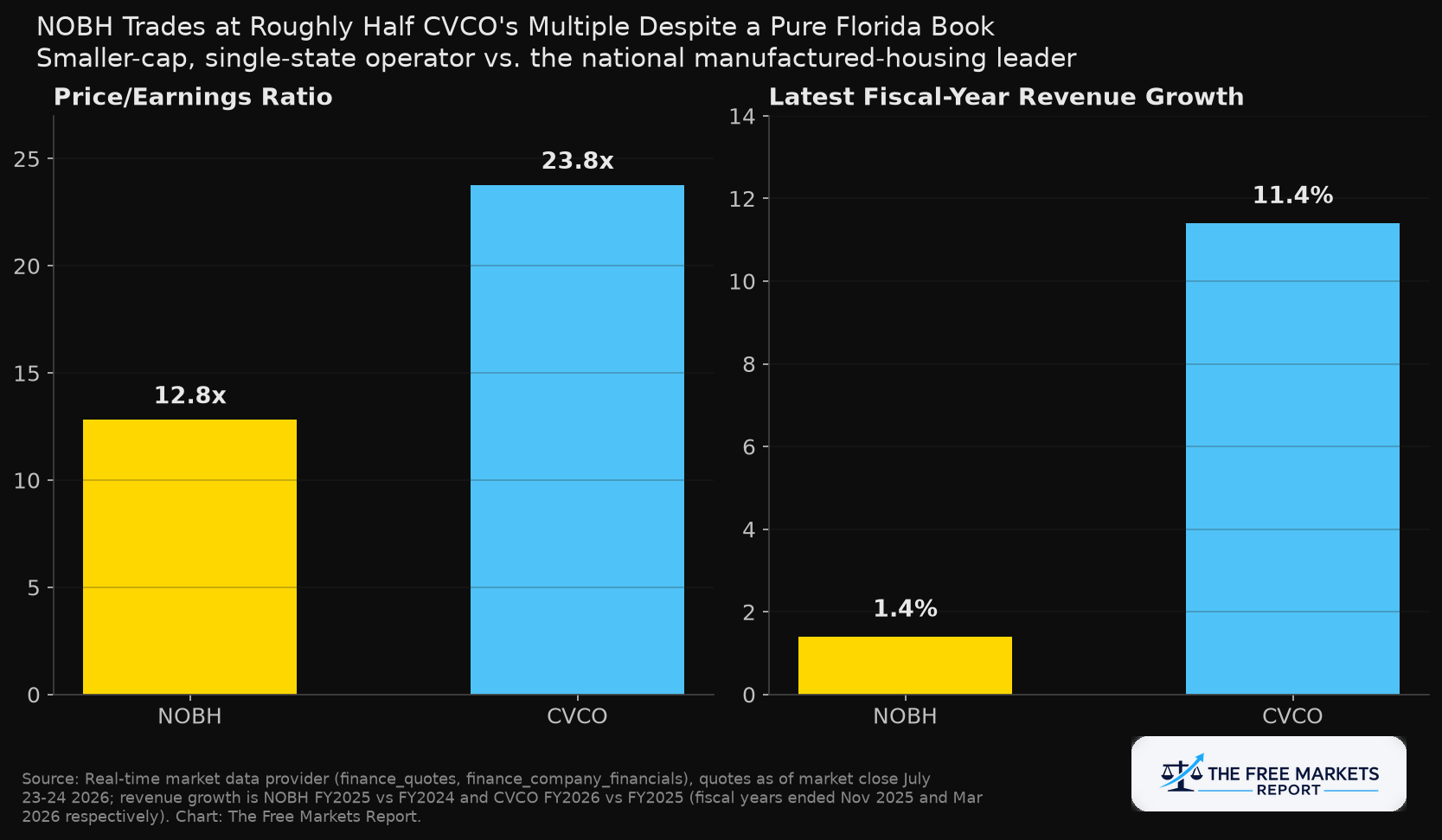
- Nobility Homes (NOBH), the only vertically integrated manufactured home maker headquartered in Florida, trades at a 12.8x price-to-earnings ratio versus a 23.8x implied multiple for national peer Cavco Industries (CVCO).
- Florida is the No. 2 manufactured housing market in the country by shipment volume, with 6,287 units shipped January through November 2025, trailing only Texas.
- Watch: DBPR's implementation guidance for the offsite-construction preemption clause and whether local building departments continue site-built-only zoning overlays into 2027.
The bill cleared the Florida House 114-0 on February 25, 2026, and the Senate 37-0 on March 5, 2026. That margin does not happen on a partisan wedge issue. It happens when every local official has watched a permit office slow-walk a routine repair, and every homebuilder has watched a zoning board exclude a factory-built model from a subdivision that would otherwise welcome it.
The Mechanism: A Permit Floor and a Zoning Backstop
Start with the numbers. Local governments must now exempt single-family homeowners and contractors from permitting for repair work valued under $7,500, with no partial exemption once a project crosses that threshold. Electrical, plumbing, structural, mechanical, and gas work stay inside the permit system regardless of cost, and homes in FEMA flood hazard areas are excluded entirely. That is a real floor-raising for repairs that used to require a permit, a fee, and an inspector visit for an illustrative sub-$7,500 kitchen fix.
The zoning provision matters more for investors. HB 803 prohibits local governments from enforcing any zoning or land-use rule that treats offsite-constructed dwellings more restrictively than site-built dwellings in the same district. This is a direct legislative override of the tool zoning boards have used for decades to keep manufactured and modular homes out of neighborhoods that would otherwise welcome them on cost grounds alone. Permits also now expire one year after issuance, or upon the next Building Code edition, rather than sitting open indefinitely.
None of this is exotic policy. It is unglamorous administrative cleanup that rarely makes a headline. That is exactly why it is underpriced.
Who Actually Benefits
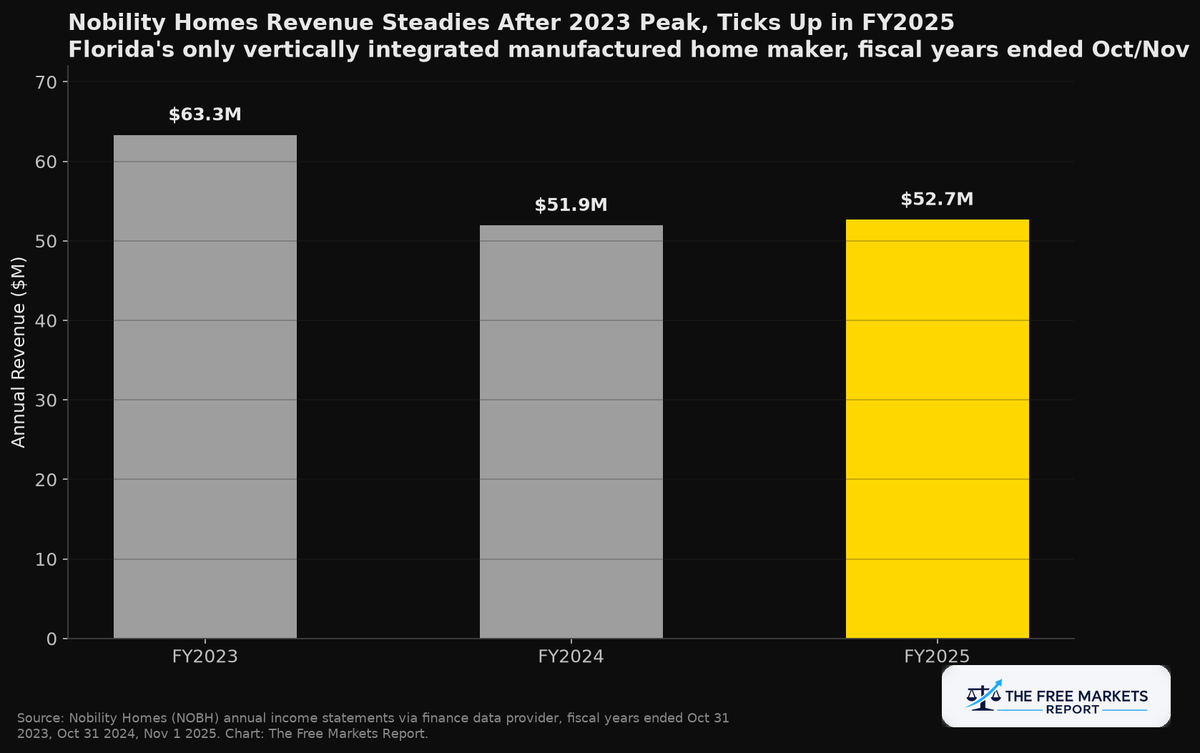
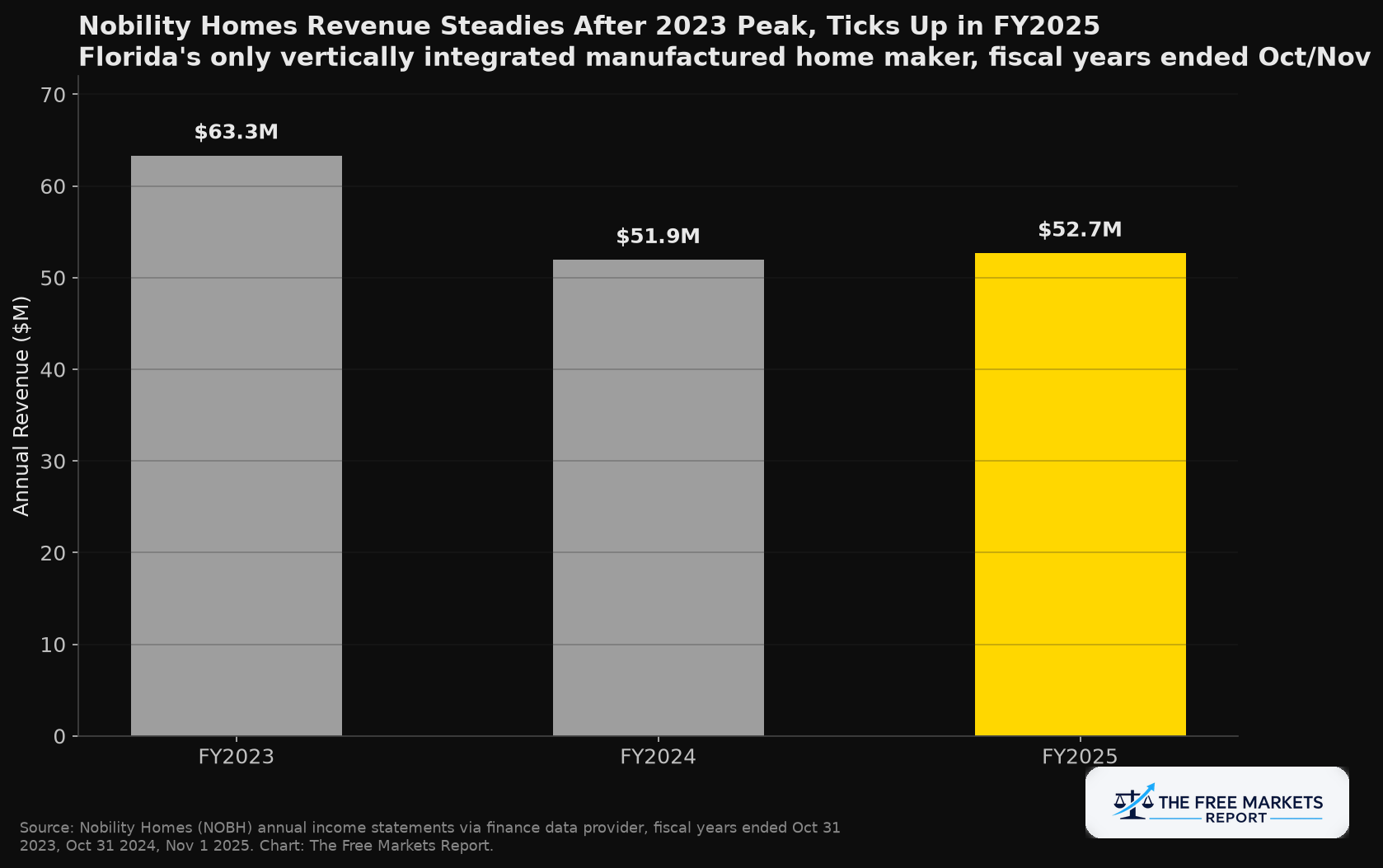
Nobility Homes (NOBH) is the cleanest publicly traded expression of this thesis. Florida-incorporated and headquartered in Ocala, it describes itself as the only vertically integrated manufactured home company headquartered in the state, combining manufacturing, company-owned retail centers, and an insurance agency subsidiary. Revenue came in at $52.7 million in fiscal 2025, up 1.4% from $51.9 million in fiscal 2024, after a fiscal 2023 peak of $63.3 million, with a 16.0% net margin. The stock trades at $30.00, a market cap of $94.6 million, and a trailing P/E of 12.8x, inside a 52-week range of $24.75 to $35.71.
For scale, Cavco Industries (CVCO), the largest US manufactured home producer with Florida factories in Ocala and Plant City, posted fiscal 2026 revenue of $2.24 billion, up 11.4% from $2.02 billion, with an 8.5% net margin. CVCO trades at $569.77, a market cap of $4.39 billion, and a 23.8x trailing multiple. Cavco is the diversified way to play the same tailwind. Nobility is the concentrated one.
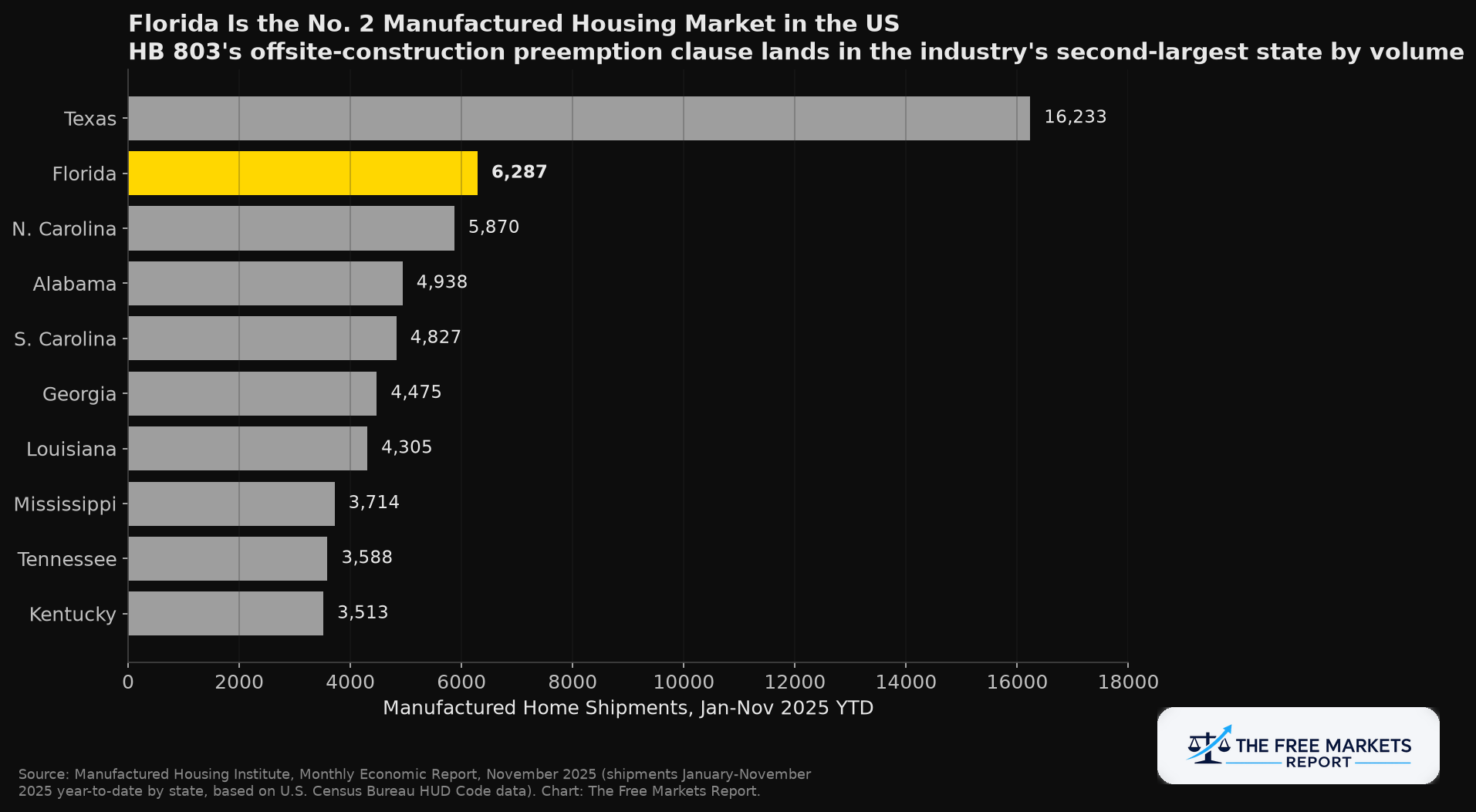
Florida shipped 6,287 new manufactured homes January through November 2025, second nationally behind Texas and ahead of North Carolina, Alabama, and every other Southeast market. Shipments were down 9.8% year over year through that period against a roughly flat national total, a demand air pocket that a permitting and zoning tailwind is built to offset, not reverse outright.
The Case for Skepticism
The textbook expectation says a permitting law should show up immediately in a homebuilder's order book. It has not, at least not yet. NOBH's fiscal 2025 revenue grew just 1.4%, and Florida's shipment volume fell for the trailing eleven months of 2025, before HB 803 took effect. The bill did not become law until July 1, 2026, so none of the fiscal 2025 results reflect it. This is a forward catalyst, not a confirmed one.
There is also real implementation risk. HB 803 requires DBPR to issue guidance on the offsite-construction preemption clause. If local departments interpret that language narrowly, or rulemaking drags, the practical effect could lag the statute's effective date by a year or more. HOAs also retain broad review authority over improvements even though HB 803 bars them from requiring a government permit as a precondition, a workaround the statute does not fully close.
Investment Idea
INVESTMENT IDEA: Nobility Homes, Inc. (NOBH)
Thesis type: Primary beneficiary
Deregulatory catalyst: Florida CS/CS/HB 803 (Chapter 2026-63), effective July 1, 2026, preempting local zoning discrimination against offsite-constructed homes.
Current price: $30.00 (finance data provider, close July 23, 2026).
Key financial data: Fiscal 2025 revenue $52.7 million, net margin 16.0%, trailing P/E 12.8x.
Regulatory constraint removed: Local zoning boards can no longer apply siting standards to factory-built homes stricter than site-built homes in the same district, a decades-old friction point in Florida permitting.
Bull case: If departments implement the zoning-preemption clause as written, NOBH's addressable subdivision base expands into districts that previously excluded manufactured housing on land-use grounds alone.
Bear case: Revenue growth was flat at 1.4%, and Florida shipments fell 9.8% year over year through November 2025, entirely before HB 803 took effect. The catalyst is unconfirmed and depends on DBPR guidance that could lag into 2027.
What to watch: NOBH's fiscal 2026 results for change in Florida unit volume, and DBPR's rulemaking timeline. No measurable shipment change by the November 2026 year-end report would leave the thesis unconfirmed.
Time horizon: 12-24 months.
The Principle
A 114-0 permitting vote does not sound like an investment catalyst. It rarely gets covered as one. But the mechanism is specific, the beneficiary is nameable, and the exposure is public and liquid. Boring, unanimous, procedural deregulation is still deregulation. Florida did not subsidize manufactured housing. It stopped letting local governments penalize it. That distinction is the entire thesis.
The Free Markets Report is provided by Lead-Lag Publishing, LLC. All opinions and views mentioned in this report constitute our judgments as of the date of writing and are subject to change at any time. Information within this material is not intended to be used as a primary basis for investment decisions, and should also not be construed as advice meeting the particular investment needs of any individual investor. Trading signals produced by The Free Markets Report are independent of other services provided by Lead-Lag Publishing, LLC, or its affiliates, and the positioning of accounts under their management may differ. Please remember that investing involves risk, including loss of principal, and past performance may not be indicative of future results. Lead-Lag Publishing, LLC, its members, officers, directors, and employees expressly disclaim all liability with respect to actions taken based on any or all of the information in this writing.
Footnotes
- Florida Senate, Bill History, CS/CS/HB 803 (2026): [flsenate.gov/Session/Bill/2026/803](https://www.flsenate.gov/Session/Bill/2026/803)
- Florida House of Representatives, Bill Analysis, CS/CS/HB 803, Insurance & Banking Subcommittee: [flsenate.gov/Session/Bill/2026/803/Analyses/h0803c.IAS.PDF](https://www.flsenate.gov/Session/Bill/2026/803/Analyses/h0803c.IAS.PDF)
- Nobility Homes, Inc., Form 10-Q, quarter ended January 31, 2026: [sec.gov/Archives/edgar/data/72205/000119312526110303/ck0000072205-20260131.htm](https://www.sec.gov/Archives/edgar/data/72205/000119312526110303/ck0000072205-20260131.htm)
- Nobility Homes, Inc. financial data, fiscal years 2023-2025, via finance data provider.
- NOBH and CVCO market quotes (price, market cap, P/E, 52-week range), via finance data provider, as of July 23, 2026.
- Cavco Industries, Inc., Form 10-K and annual report, fiscal years 2025-2026: [stocktitan.net/sec-filings/CVCO/10-k-cavco-industries-inc-files-annual-report-181ebc0344ff.html](https://www.stocktitan.net/sec-filings/CVCO/10-k-cavco-industries-inc-files-annual-report-181ebc0344ff.html); [sec.gov/Archives/edgar/data/278166/000027816624000091/fy24annualreport.pdf](https://www.sec.gov/Archives/edgar/data/278166/000027816624000091/fy24annualreport.pdf); manufacturing locations per [cavcohomes.com/manufacturing](https://www.cavcohomes.com/manufacturing)
- Manufactured Housing Institute, Monthly Economic Report, November 2025: [manufacturedhousing.org/wp-content/uploads/2026/01/MHI-Economic-Report-November-2025.pdf](https://www.manufacturedhousing.org/wp-content/uploads/2026/01/MHI-Economic-Report-November-2025.pdf)